

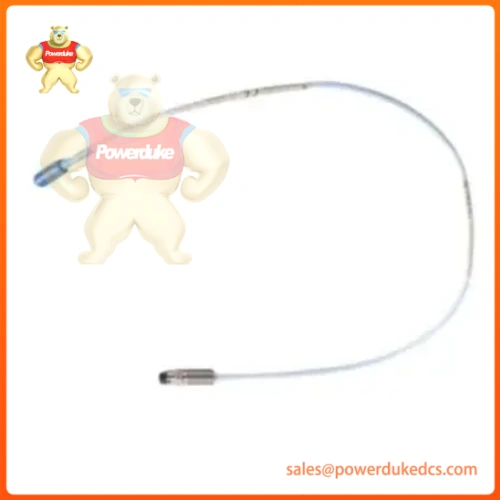
Description

- Model & Brand: Bently Nevada (Baker Hughes) / 3300 NSv Series (Catalog No. 330910-06-13-10-02-CN / Proximity Probe Assembly)
- Physical Dimensions: Standard M10 × 1 thread profile with integral probe tip and armored cable configuration (Approx. 1.0 m total system cable length design option)
- Estimated Shipping Weight: 0.12 kg (Packaged in multi-layer anti-static ESD shielding and structural foam crating)
- What’s in the Box: 3300 NSv probe unit with armored cable, miniature coaxial ClickLoc connector, connector protector, and factory calibration verification sheet.
Rotating machinery featuring small clearances, tight measurement locations, or specialized geometries—such as high-speed centrifugal compressors, small steam turbines, and specialized motor-generator sets—require specialized non-contact transducers capable of linear tracking without field interference. System engineers integrate the Bently Nevada 330910 NSv Proximity Probe Assembly directly into critical turbomachinery installations to measure radial vibration, axial position, and shaft dynamic displacement (—which is vital for monitoring machines where standard 8 mm probes experience side-view or edge effects, ensuring precise asset health tracking and preventing catastrophic internal rubs).
Technicians must ensure proper probe gap setting (typically −10 VDC initial resting voltage or mid-range linear mV/mil output) and maintain solid coaxial shield grounding to prevent high-frequency electrical noise from corrupting vibration telemetry.
| Parameter | Value |
| System Platform | Bently Nevada 3300 NSv (Non-Standard/Small target) Proximity System |
| Transducer Type | Eddy-current non-contact proximity probe |
| Probe Tip Diameter | 5 mm or specialized NSv profile (compatible with NSv Proximitor sensors) |
| Linear Range | 1.5 mm (60 mils) nominal linear operating range |
| Sensitivity | 7.87 V/mm (200 mV/mil) nominal scale factor |
| Operating Temperature | -51°C to +177°C (-60°F to +350°F) probe tip environment range |
| Enclosure / Cable Protection | Optional stainless steel armor over high-temperature FEP insulated coaxial cable |
Auditors inspecting critical turbomachinery safety instrumented systems and hazardous location installations require rigorous documentation verifying electrical safety, environmental ruggedization, and hazardous area certifications.
- CE Mark: Confirms conformity with European Union directives covering electromagnetic compatibility (EMC) and low-voltage safety.
- cULus / CSA Listed: Validates North American standards for hazardous and non-hazardous industrial locations.
- ATEX / IECEx Approvals: Certified for deployment in explosive gas atmospheres (Zone 0/1/2 hazardous areas).
- RoHS Compliance: Restricts hazardous chemical substances in electronic component manufacturing.
Compliance Note: Compliance with API 670 specifications for machinery protection systems ensures that non-contact probe signals maintain linearity and high thermal stability across extreme operating conditions. Verify specific hazardous area installation control drawings with Baker Hughes prior to plant safety audits.
Dormant proximity probes stored in warehouse stockroom bins face mechanical sheath degradation and connector oxidation if environmental parameters escape strict control limits.
Keep the probe assembly sealed tightly inside its original anti-static (ESD) moisture-barrier bag to safeguard the precision tip and coaxial connector pins from static discharge and particulate contamination. Maintain warehouse storage temperatures between -51°C and +105°C with relative humidity kept strictly below 95% non-condensing to prevent terminal micro-corrosion on ClickLoc connector contacts. Ensure the hardware remains protected from heavy physical drop forces that could fracture the ceramic probe tip or crush the stainless steel armor casing.
Thread alignment and precise mechanical gapping dictate physical installation success on machinery mounting brackets. Ensure all machinery rotation and auxiliary hydraulic supplies are completely locked out (LOTO) prior to handling. Thread the M10×1 probe body into the bracket using proper locking nuts, adjust the air gap relative to the shaft target using a multitester to read the target -10 VDC gap voltage, and lock down securely to eliminate mechanical vibration loosening.
- What is the correct HS Tariff Code for international customs clearance?Industrial monitoring instruments and vibration measuring transducers classify under harmonized code 9031.80.8085 (or regional equivalent 9031.80), though exact regional rulings should be verified with your broker.
- Does this proximity probe require a matching NSv Proximitor sensor?Yes, the 330910 NSv probe must be paired with a compatible 3300 NSv Proximitor sensor and extension cable to ensure correct signal scaling and linearity for small targets.
- How does the Country of Origin (COO) impact global trade compliance?The verified COO dictates trade agreement qualification and must match commercial shipping paperwork to eliminate border customs clearance delays.
- Why is comprehensive transit insurance mandatory for this component?Delicate ceramic probe tips, fine coaxial cabling, and miniature ClickLoc connectors can suffer structural strain or internal micro-fractures under severe drop impacts during freight transit.






