Description
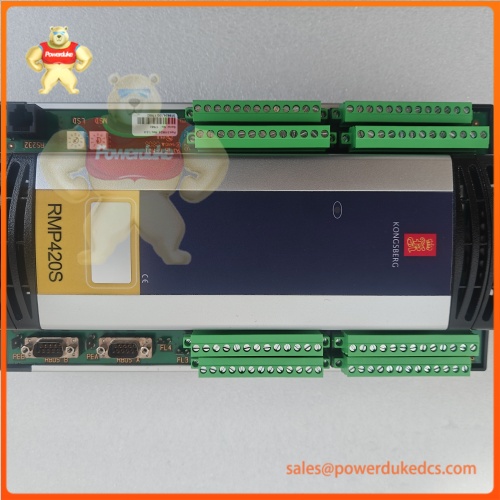
1.Unboxing & Physical Snapshot (Dynamic List)
- Brand & Model: Kongsberg Maritime / RPM420S Remote Multipurpose Input/Output Module
- Physical Dimensions: Approximately 42.2 cm x 12.4 cm x 12.6 cm
- Estimated Shipping Weight: 1.1 kg (Packaged within high-density antistatic foam cushioning)
- What’s in the Box: Multipurpose I/O circuit assembly, pluggable terminal blocks, and factory compliance tags. (Note: Interconnecting redundant process bus cables are sold separately).
2.Product Introduction
Vessel engine rooms and offshore drilling modules subject electronic hardware to relentless humidity, thermal fluctuations, and continuous low-frequency mechanical vibration—which is hazardous for standard commercial automation components. Marine instrumentation technicians mount this multipurpose I/O unit inside protected steel distribution enclosures, routing hundreds of discrete and analog field lines through its front-face termination blocks to maintain continuous telemetry with central bridge computers.
Operational reliability depends on deploying verified OEM hardware rather than unverified surplus alternatives. Utilizing this exact dual-bus module ensures deterministic signal acquisition and galvanic isolation across safety-critical loops, preventing erroneous alarm trips during high-load vessel maneuvers.
3.Core Technical Specifications
| Parameter | Value |
|---|---|
| Manufacturer / Series | Kongsberg Maritime / RIO400 Architecture |
| Part Number / Catalog ID | RPM420S |
| Channel Configuration | 32 software-configurable multipurpose solid-state channels |
| Signal Compatibility | AI, AO, DI, DO, 2/3-wire RTD, and pulse/frequency inputs |
| Communication Interface | Dual Remote I/O process bus (redundant architecture) |
| Power Supply Input | 24V DC nominal bus |
| Operating Temperature | -15°C to +70°C maritime threshold |
| Approximate Weight | 1.1 kg (2.43 lbs) |
- Global Compliance & Industry Certifications
Auditors and classification societies require strict documentation proving that marine automation hardware withstands harsh operational environments. This module carries essential compliance benchmarks, including the CE Mark, ATEX / IECEx ratings for Ex Zone 2 hazardous areas, and typical marine society type approvals like DNV GL.
A verified Ex Zone 2 rating ensures that internal low-energy switching circuitry will not generate sparks capable of igniting volatile hydrocarbon gases present in offshore production spaces. Verify specific lot certifications with OEM.
5.Long-Term Storage & Asset Preservation Guide (E-E-A-T Goldmine)
Spare modules warehoused in coastal facilities face accelerated risks from salt-laden air and atmospheric moisture condensing on bare contact pins. Leave the unit securely sealed inside its original factory anti-static moisture-barrier bag until the exact day of cabinet installation. Maintain stockroom climate controls with ambient temperatures stable between 10°C and 30°C and relative humidity kept strictly below 60 percent to prevent conformal coating breakdown. Because this unit relies on solid-state architecture without internal backup lithium cells or large electrolytic bulk capacitors, shelf-storage maintenance remains straightforward as long as stock bins stay elevated off concrete floors.
- Physical Installation Prerequisites
Mount the unit securely onto a heavy-duty DIN rail or panel backing inside a grounded metal enclosure, leaving at least 50mm of vertical clearance above and below the housing to permit unrestricted convection airflow through the cooling slots. Ensure that the dual process bus communication shields bond securely to the cabinet earth bar to suppress high-frequency electromagnetic interference from nearby variable-frequency drives.
- Buyer’s FAQ (Logistics & Compliance Focus)
- What Harmonized System (HS) tariff code governs international shipments of this I/O module? Industrial process control units and modular automation parts typically fall under HS code 8538.90 (parts suitable for use solely with electrical control apparatus), though customs brokers should verify local classifications.
- Does the module ship pre-loaded with application firmware? Hardware arrives with foundational system ROM installed, but field engineers must configure channel parameters and node addresses using the project engineering tool prior to commissioning.
- How does the Country of Origin (COO) affect trade compliance documentation? Official manufacturing country declarations (Norway) must match commercial export invoices precisely to clear customs inspections without incurring tariff delays or secondary audits.
- What level of transit insurance is recommended during freight delivery? Full-value commercial cargo insurance coupled with shock-impact indicator labels is mandatory to protect sensitive electronics against rough handling during international transit.