Description
1. At-A-Glance Executive Brief
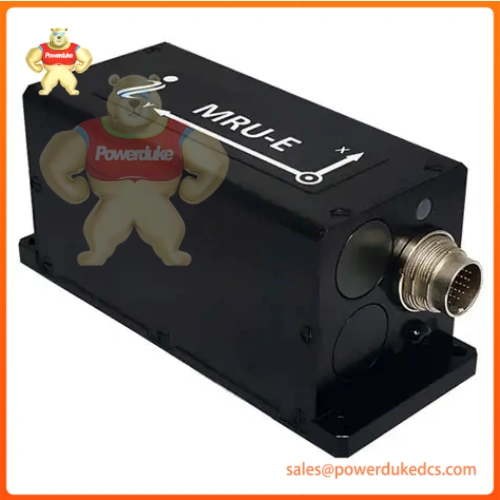
- Model: MRU-E-CS1-3M (MRU-E Series)
- Brand: Kongsberg / Kongsberg Seatex
- Part Type: Marine Motion Reference Unit (MRU) / Inertial Sensor Module
- Lifecycle Status: Active / Standard Support Line
- Weight: ~2.5 kg
- Core Application: Real-time roll, pitch, heave, and linear acceleration measurement for dynamic positioning (DP) and marine navigation
2. Technical Introduction
An unexpected sensor failure or data drift in a vessel’s motion reference unit can compromise dynamic positioning (DP) stability, disrupt offshore crane operations, and trigger automatic safety cutouts during critical offshore maneuvers.
The Kongsberg MRU-E-CS1-3M is a high-precision, fifth-generation motion reference unit engineered to deliver real-time, phase-free roll, pitch, heave, and acceleration measurements in extreme marine environments. Integrating advanced MEMS technology with specialized signal processing algorithms, it provides ultra-reliable compensation data for offshore vessels, hydrographic surveying equipment, and helideck monitoring systems. Deploying a verified original replacement sensor restores precise spatial orientation and navigational integrity without requiring control system reconfiguration.
Engineer’s Takeaway: Procuring an authentic Kongsberg MRU-E-CS1-3M ensures exact mechanical mounting compatibility, correct lever-arm compensation parameters, and seamless NMEA communication handshakes with vessel automation networks.
3. Core Technical Specifications
| Parameter | Value |
| Manufacturer | Kongsberg Gruppen / Kongsberg Seatex |
| Model / Part Number | MRU-E-CS1-3M |
| System Family | MRU E-Series Marine Motion Sensors |
| Measurement Parameters | Roll, Pitch, Heave, Yaw, and 3-Axis Linear Accelerations |
| Roll/Pitch Static Accuracy | \pm 0.03^\circ RMS |
| Roll/Pitch Dynamic Accuracy | \pm 0.01^\circ (1-sigma) |
| Input Voltage | 24 V DC nominal auxiliary power |
| Communication Interfaces | RS-422, RS-485, Ethernet |
| Supported Protocols | NMEA 0183, NMEA 2000, proprietary Kongsberg formats |
| Enclosure Rating | Marine-grade ruggedized housing |
| Operating Temperature | -25^\circC to +70^\circC extended range |
| Net Weight | ~2.5 kg |
4. Field Engineer’s Tech Notes
- Lever Arm and Alignment Configuration: Ensure that the physical installation orientation matches the lever-arm offset coordinates configured in the onboard Kongsberg configuration software. Even minor discrepancies in mounting azimuth or coordinate offsets will introduce calculation errors into dynamic positioning and crane stabilization loops.
- Power Supply Ripple and Cabling Isolation: Use double-shielded twisted-pair cables for serial and Ethernet lines, terminating shield drains correctly to the housing ground lug. Voltage transients or electromagnetic interference (EMI) from nearby variable frequency drives can corrupt high-frequency 200 Hz update packets.
5. Adaptive QA & Testing Protocol
Every unit undergoes rigorous bench validation prior to dispatch. For the Kongsberg MRU-E-CS1-3M, our technicians mount the unit on a precision multi-axis tilt and vibration test fixture to verify static roll/pitch accuracy, test real-time heave tracking response, and validate communication handshakes across Ethernet and serial ports. Functional test reports or pre-shipment video verification can be provided upon request.
6. Buyer’s FAQ
- Are these motion reference units supplied as New Surplus or refurbished?
We stock both factory-sealed New Surplus (NSFP) and fully bench-tested, static-safe overhauled units. Condition status is explicitly marked on every quote.
- What warranty coverage comes with this part?
All replacement marine automation sensors are backed by a standard 12-month operational warranty from the date of invoice.
- How fast can this MRU unit ship to minimize vessel downtime?
In-stock items ship same-day via priority air courier services to global maritime ports or agents, mitigating critical path delays during vessel turnaround windows.
- Does the replacement unit require software recalibration upon installation?
While factory calibration is pre-loaded, operators must verify that the specific vessel configuration file, lever-arm offsets, and communication baud rates are correctly uploaded via the configuration software before putting the DP system back online.