

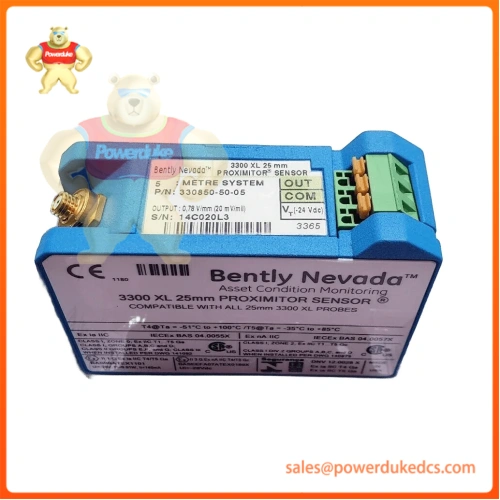
Description
1. Unboxing & Physical Snapshot
- Model & Brand: Bently Nevada (Baker Hughes) 3300 NSv Accelerometer — Part Number: 330850-50-05
- Physical Dimensions: Compact low-profile sensor housing, approximately 25 mm diameter base with integrated mounting stud and hermetically sealed coaxial cable interface.
- Estimated Shipping Weight: 0.35 kg (Packaged in anti-static cushioning bubble wrap and secure corrugated carton)
- What’s in the Box: Bently Nevada 330850-50-05 NSv accelerometer sensor, integral certified cable assembly, protective dust caps, and factory compliance documentation sheet.
2. Product Introduction
Structure A (Environmental hook): Designed to survive extreme industrial machinery environments subject to high-frequency structural vibration, intense thermal shifts, and continuous oil exposure, this low-profile accelerometer monitors high-speed rotating assets. Within the Bently Nevada 3300 vibration monitoring framework, it captures small-amplitude vibration data on compact or specialized bearings where standard sensors fail to fit.
Housed within a corrosion-resistant stainless-steel body, the internal piezoelectric sensing element maintains long-term signal stability. Its hermetically sealed construction blocks moisture and process contaminants from degrading the internal electronics (—which is vital for reliable continuous condition monitoring on critical compressors and pumps).
3. Core Technical Specifications
| Parameter | Value |
| Sensitivity | 100 mV/g (10.2 mV/(m/s^2)) nominal |
| Frequency Response | 0.5 Hz to 10 kHz (\pm 3 dB) |
| Amplitude Range | Up to 80 g peak operational limit |
| Temperature Range | -51°C to +121°C (-60°F to +250°F) |
| Power Supply / Current | -24 VDC nominal constant current source (2 mA to 20 mA) |
| Enclosure / Housing Material | Corrosion-resistant 316L stainless steel |
| Mounting Thread | Configured via option code (Integral stud mount) |
| Physical Weight | Approximately 0.15 kg (Sensor unit excluding cable) |
4. Global Compliance & Industry Certifications
Auditors reviewing machinery protection systems require valid hazardous area and electrical safety documentation to certify plant monitoring loops.
- Expected Certifications: CE Mark, RoHS compliance, and ATEX / IECEx / CSA hazardous area approvals for Class I, Division 1 / Zone 0 or Zone 1 environments.
- Safety Relevance: The rigorous hazardous location listing ensures that the low-energy sensor loop will not ignite explosive gases or volatile hydrocarbon vapors surrounding compressor skids during fault conditions.
- Audit Note: Cross-reference sensor serial numbers and option code suffixes against your machinery protection system database prior to permanent field stud mounting.
5. Long-Term Storage & Asset Preservation Guide
Veteran Maintenance Note: Precision vibration sensors left sitting in warehouse inventory require clean packaging discipline to protect delicate threaded studs and coaxial micro-connectors from physical damage.
- Connector Protection: Keep the integrated cable connector sealed inside its protective dust cap and anti-static pouch to prevent microscopic dust or moisture contamination on the pin contacts.
- Environmental Control: Maintain warehouse storage relative humidity below 50% non-condensing to prevent atmospheric tarnishing of the stainless-steel housing and cable shielding.
- Physical Cushioning: Store sensors individually in foam slots; never toss multiple raw transducers loosely into bins where impact forces can fracture the internal piezoelectric crystal assembly.
6. Physical Installation Prerequisites
- Prepare a flat, spot-faced mounting surface on the machinery bearing housing to ensure 100% mechanical contact area for optimal high-frequency vibration transmission.
- Torque the mounting stud strictly to manufacturer specifications (typically using a calibrated torque wrench) to prevent stud shear or decoupling errors.
- Route the armored sensor cable away from high-voltage motor power lines, securing it with clamps to eliminate cable whip and motion-induced false signal noise.
7. Buyer’s FAQ (Logistics & Compliance Focus)
- What Harmonized System (HS) code governs international customs processing?
The standard global export classification for this vibration sensor is 9031.80.8085 (Instruments and appliances for measuring or checking electrical quantities or non-electrical variables).
- How does Country of Origin (COO) verification impact capital spare audits?
Accurate origin tagging ensures compliance with trade regulations; verify the manufacturing origin label (typically United States) on the outer shipping box.
- Does this accelerometer require a specialized monitor channel?
Yes, it integrates directly with compatible Bently Nevada 3300 or 3500 monitoring system rack channels configured for 100 mV/g vibration inputs.
- What level of transit insurance should be specified?
Always mandate fully declared-value air cargo insurance to protect delicate internal piezoelectric elements against heavy drop impacts during international shipping.






