

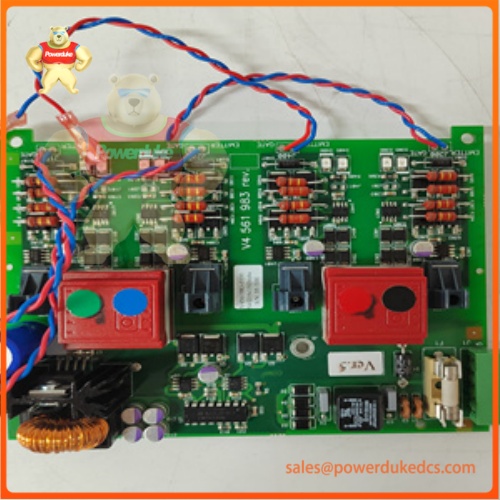
Description
 1. Unboxing & Physical Snapshot
- Model & Brand: Alstom (now part of GE / General Electric) — V4561983-0100 (Digital Input / Control Card Module)
- Physical Dimensions: Standard industrial modular card profile designed for proprietary Alstom control racks and DCS backplanes.
- Estimated Shipping Weight: 0.6 kg (1.32 lbs) packed in heavy-duty anti-static bubble shielding and structural corrugated packaging.
- What’s in the Box: V4561983-0100 module unit, front-panel LED status indicator overlay, extraction handle, and compliance information insert (note: mating terminal blocks and rack backplanes are ordered separately).
2. Product Introduction
Harsh electrical noise, continuous plant cycles, and strict safety requirements demand high-reliability digital input processing within heavy industrial power generation and turbine control systems. Operating as a core input/control module within Alstom automation architectures (frequently deployed in turbine management and air-cooled condenser monitoring systems), this card acquires and processes discrete field status signals.
Engineered with high-density optocoupler isolation circuits, the module maps 24VDC switch states directly to the central processing framework while shielding internal logic from field-induced electrical transients. Plant instrumentation engineers rely on this hardware component to maintain precise, real-time status monitoring across continuous industrial processes.
3. Core Technical Specifications
| Parameter | Value |
| Product Brand / Series | Alstom Industrial Automation / DCS Control Line |
| Module Type | 16-Channel Digital Input (DI) / Control Card |
| Input Signal Range | 24 VDC discrete switch inputs |
| Isolation Architecture | Optically isolated channel-to-logic boundaries |
| Backplane Interface | Proprietary Alstom high-density card-edge connector bus |
| Operating Temperature | 0^\circC to +60^\circC (32^\circF to 140^\circF) |
| Storage Temperature | -40^\circC to +85^\circC (-40^\circF to +185^\circF) |
| Enclosure Rating | IP00 raw modular card assembly (housed in sealed control cabinet rack) |
4. Global Compliance & Industry Certifications
Regulatory safety audits demand verified compliance documentation when replacing legacy control cards in heavy industrial environments.
- Certifications: CE Mark, industrial electromagnetic compatibility (EMC) directives, and RoHS environmental compliance standards.
- Safety Relevance: The optical isolation circuitry ensures that high-voltage spikes or grounding faults originating on long field sensor wiring cannot breach the backplane barrier, protecting central processors and panel operators.
- Audit Note: Verify specific hardware revision codes and firmware/gate-array configurations against your system technical specifications prior to final loop sign-off.
5. Long-Term Storage & Asset Preservation Guide
Spare electronic control modules stored in warehouse stockrooms face component aging, humidity, and pin oxidation over extended durations (—requiring strict environmental management to protect capital inventory). Preserve your investment by executing these procedures:
- Maintain indoor warehouse climates where ambient storage temperatures stay between -20^\circC and +55^\circC while keeping relative humidity strictly below 60% non-condensing to prevent micro-corrosion on gold card-edge traces.
- Keep the module sealed inside its original factory anti-static moisture-barrier bag alongside active desiccant packs until the exact installation window.
- Inspect the card-edge contacts and front diagnostic LEDs annually for dust accumulation, brushing surfaces gently with clean, dry compressed air if necessary.
6. Physical Installation Prerequisites
Proper mechanical alignment and electrostatic discharge protection inside the control cabinet are critical during module replacement.
- Clearance Space: Ensure unobstructed vertical airflow paths above and below the rack slot to permit adequate thermal dissipation.
- Grounding Requirements: Always wear an approved anti-static wrist strap connected to the cabinet ground stud before handling or sliding the module into the rack.
- Insertion Protocol: Align the board edges carefully with the sub-rack guide rails, pushing straight back smoothly until the rear connectors seat completely and locking levers latch into place.
7. Buyer’s FAQ (Logistics & Compliance Focus)
Q: What Harmonized System (HS) Tariff Code applies to this Alstom module for international shipments?
A: Industrial control system interface cards and processor parts typically classify under HS code 8538.90.8180 (Parts suitable for use solely or principally with control apparatus). Always verify final classifications with your customs broker.
Q: Does this electronic module require pre-programming or firmware configuration?
A: As a hardware input card, it typically relies on system-level configuration managed via the primary controller software project, though hardware jumper settings should be verified against the unit being replaced.
Q: What is the Country of Origin (COO) for trade compliance record-keeping?
A: Alstom industrial automation hardware was manufactured primarily in European production facilities (such as France or the UK), requiring accurate country declarations on commercial import paperwork.
Q: Is specialized transit insurance required for international cargo delivery?
A: Yes, because multi-layer surface-mounted circuit boards and sensitive integrated circuits are vulnerable to drop impacts and shock loads, comprehensive freight insurance is strongly recommended.






