Description
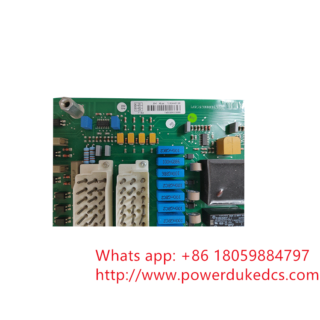
The ABB 1MRK000508-BD is a 16-channel Binary Input Module (BIM) engineered for the Relion 670 and 650 series Intelligent Electronic Devices (IEDs), such as the RED670, REG670, and RET670 protection and control systems. This module processes external digital state changes from auxiliary contacts, control switches, and field sensors into logic levels for power system automation schemes. Operating with a threshold voltage rating of 110 V DC to 125 V DC, the unit incorporates hardware-level filtering to ensure dependable fault monitoring and signal integrity within high-voltage substation environments.
Technical Specifications
| Parameter | Value / Specification |
| Model / Ordering Code | 1MRK000508-BD (e.g., variant revisions such as r04) |
| Global Commercial Alias | BIM (Binary Input Module) |
| Brand | ABB / Hitachi Energy |
| System Compatibility | Relion 670 / 650 Series IEDs (REx670 V1.1 / V1.2 platform architectures) |
| Number of Inputs | 16 independent binary channels |
| Rated Control Voltage (U_r) | 110 to 125 V DC |
| Threshold Voltage (RL110) | Sized for 110 V DC nominal auxiliary networks |
| Maximum Current Inrush | ~50 mA at activation (with dynamic power management stabilization) |
| Power Consumption | Max 0.5 W per active channel |
| Isolation Voltage | 2,500 V AC between field circuits and internal IED backplane |
| Dimensions (Approx.) | 20 mm (W) x 198 mm (H) x 262 mm (D) |
| Product Net Weight | 0.41 kg (0.90 lbs) |
| Country of Origin | Sweden / Switzerland |
Commercial and Logistics Terms
- Condition: New Original (Factory Sealed)
- Warranty: 12-Month Comprehensive Warranty
- Availability: In Stock / Available for Order
- Lead Time: Ships within 1 to 2 business days from order confirmation
- Pricing: Price subject to market conditions; contact us for a firm quote
Engineering Overview & Integration Notes
In electrical substation automation design, binary input modules act as the vital bridge between rugged physical plant hardware (like circuit breaker auxiliary switch blades) and high-speed protection logic processors.
Voltage Threshold Coordination & False Trigger Mitigation
The 1MRK000508-BD uses an active threshold circuit labeled RL110. This design is highly intentional for 110–125 V DC battery banks:
- DC Earth Faults: Industrial DC control networks can develop accidental insulation leakage paths to earth. This module features a high threshold voltage configuration to ensure that capacitive discharge or partial earth-fault voltages do not cause a false logic high detection.
- Debounce Filtering: The module firmware applies a configurable hardware debounce filter (typically adjustable from 1 ms to 50 ms within the PCM600 configuration software) to block high-frequency inductive switching noise or mechanical contact bounce.
Physical Slide-In Slot Installation
- Electrostatic Discharge (ESD): This module is an unshielded circuit card assembly until fully inserted into the IED chassis casing. Use an ESD grounding wrist strap during slot handling.
- Addressing and Mapping: When inserting the module into a vacant slot (e.g., slot P3 or P4 on a standard 1/2 or 1/1 19-inch subrack), verify the rear connector pin alignment carefully before seating the card home.
- Software Configuration: You must update the IED’s hardware configuration tree inside ABB’s Protection and Control IED Manager (PCM600) to match the physical slot location. If the configured slot number does not match the real module location, the IED will throw a “Hardware Mismatch” system error and block dependent tripping matrices.
Frequently Asked Questions
Can I deploy a 1MRK000508-BD module in a 48 V DC or 220 V DC auxiliary control circuit?
No. The 1MRK000508-BD is component-tuned for 110 V DC to 125 V DC systems. Wiring it to a 48 V DC loop will fail to clear the minimum turn-on voltage threshold, preventing inputs from registering. Wiring it to a 220 V DC station battery loop will trigger excessive current draw, causing component thermal saturation and immediate hardware damage. For 220 V DC apps, specify the 1MRK000508-CD or equivalent high-voltage variant.
What is the process for replacing a failed BIM card mid-operation?
While some subrack components support hot-swapping, the safest method to avoid unintended trip matrix execution is to isolate the IED’s auxiliary power supply entirely. Unplug the external terminal block assemblies from the rear of the card, extract the faulty module, insert the replacement unit, secure the terminal blocks, and reboot the IED host frame.
How do I diagnose an inactive channel that is confirmed hot at the terminal base?
Disconnect the input connector block and check the loop resistance directly at the module input pins using a standard digital multimeter. An open-circuit reading across the primary optocoupler input loop confirms internal component degradation (often due to prolonged exposure to severe inductive voltage surges on that specific line).