Description
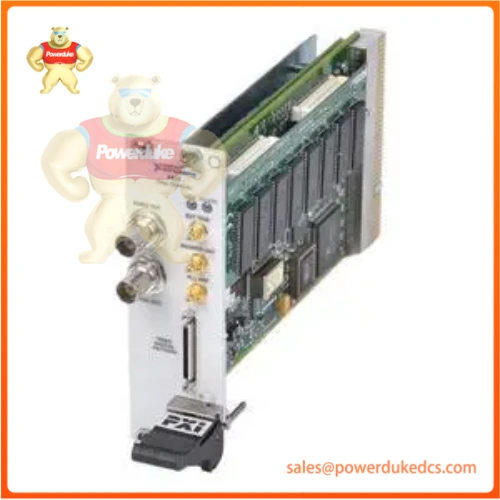
The NI PXIe-1082DC is an 8-slot, high-bandwidth PXI Express chassis designed for mobile, airborne, or vehicle-mounted test and measurement applications. Unlike standard AC-powered chassis, the “DC” variant is engineered to run directly off industrial or vehicular battery systems, providing a portable backplane for high-performance modular instrumentation.
Availability and Procurement
- Condition: New Original or Refurbished (System-level tested)
- Warranty: 12-month standard warranty; extended service levels available for mission-critical deployments
- Lead Time: 3–5 business days (subject to regional stock)
- Pricing: Indicative of high-performance NI PXIe hardware; contact our technical team for a firm, current quote.
Technical Specifications
The PXIe-1082DC balances a compact footprint with high data throughput, utilizing a PCIe Gen 2 backplane for low-latency communication between modules.
| Parameter | Specification |
| Total Slots | 8 Slots (1 System, 7 Peripheral) |
| Slot Types | 1 System, 4 PXIe Hybrid, 3 PXIe Peripheral |
| System Bandwidth | Up to 7 GB/s (total) |
| Slot Bandwidth | Up to 2 GB/s per slot (dedicated) |
| Input Voltage Range | 11 to 32 V DC (supports 12 V and 24 V systems) |
| Power Output | 352 W (Total usable power) |
| Cooling | Dual 108 CFM bottom-to-top airflow fans |
| Operating Temperature | 0 °C to 50 °C |
Backplane and Slot Configuration
Understanding the slot architecture is vital for system integration to ensure you do not bottleneck high-speed digitizers or signal generators.
- System Slot: Slot 1 is reserved for a PXI Express embedded controller or a remote control module (e.g., PXIe-8301).
- Hybrid Slots: Slots 2, 3, 4, and 5 are Hybrid slots. These can accept either PXI Express modules or standard PXI modules that use the PXI-1 connector.
- PXIe Peripheral Slots: Slots 6, 7, and 8 are dedicated PXI Express slots, optimized for modern high-bandwidth modules.
Engineering Insights: Power and Thermal Management
As a solutions architect, I have specified the PXIe-1082DC for several flight-test and automotive logging rigs. Here are the real-world constraints you must manage:
1. DC Power Stability
The 11–32 V DC input range is wide, but “dirty” power from a vehicle alternator can introduce EMI/RFI into sensitive analog measurements.
- Recommendation: Use a shielded power cable and, if possible, an external DC-DC conditioner if you are performing high-resolution (24-bit) acoustic or vibration testing.
2. Hybrid Slot Flexibility
The inclusion of 4 hybrid slots is a significant advantage. It allows you to leverage legacy PXI modules (like basic DMMs or relay switches) alongside high-speed PXIe FPGA modules or digitizers in the same chassis.
3. Thermal Clearances
The 1082DC pulls air from the bottom and exhausts through the top.
- Warning: If you rack-mount this unit, you must leave at least 1U (1.75 inches) of space above and below the chassis. Blocking the intake or exhaust will lead to rapid thermal shutdown or, worse, premature oscillator drift on your timing modules.
4. Power Budgeting
With a total capacity of 352 W, you must calculate your total load. High-performance controllers (like the PXIe-8840) and high-speed FPGAs can draw significant current. If your total calculated draw exceeds 300 W, ensure your DC supply cabling is at least 10 AWG to minimize voltage drop at the connector.
FAQ
Q: Can I use this in a standard lab with an AC outlet?
A: Not directly. This unit is built for DC environments. You would need an external AC-to-DC high-current power supply (minimum 400 W at 24 V DC) to operate it in a lab. If you only have AC power, consider the PXIe-1082 (AC version) instead.
Q: Does it support Peer-to-Peer (P2P) streaming?
A: Yes. The backplane switch fabric supports NI Peer-to-Peer streaming, allowing data transfer between modules (like a Digitizer to an FPGA) without passing data through the host controller, significantly reducing latency.
Q: How do I handle the remote power-on feature?
A: The rear of the chassis includes a remote inhibit and power-state signal terminal. This is excellent for integration into a vehicle’s ignition system so the test rig powers down automatically when the vehicle is turned off.
| NI GPIB-140A |
| NI PXIe-1095 |
| NI PXIe-1095 – 18 |