Description
1. Unboxing & Physical Snapshot
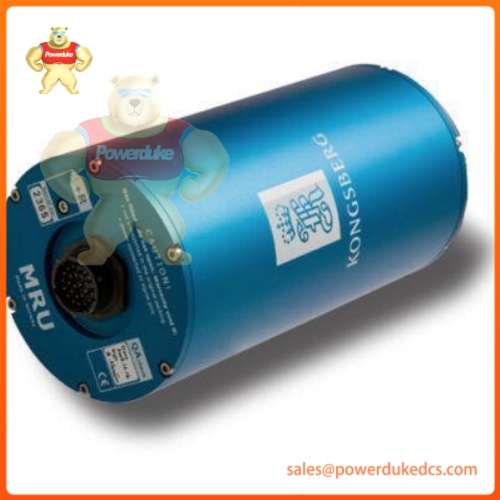
- Model & Brand: Kongsberg Seatex (Motion Reference Unit Family) — Roll and Pitch Motion Sensor — Part Number / Designation: MRU-D
- Physical Dimensions: Cylindrical marine-grade enclosure profile (Approx. Ø 105 mm × 140 mm / 4.13 in × 5.53 in; Net weight: ~1.9 kg / 4.19 lbs)
- Estimated Shipping Weight: Approximately 3.2 kg net (Packaged securely in multi-layer anti-static shielding containment, high-density molded protective foam, and heavy corrugated export cartoning)
- What’s in the Box: Kongsberg MRU-D sensor unit, configuration cable assembly with 9-pin DSUB interface, transportation storage box, and manufacturer calibration certificate/conformance documentation.
2. Product Introduction
Structure B (Architecture hook): Engineered for precision marine navigation, dynamic positioning (DP) systems, voyage data recorders, and antenna stabilization loops, the Kongsberg Seatex MRU-D functions as a high-performance, fifth-generation roll and pitch motion reference sensor. Designed to measure real-time roll, pitch angles, angular rate vectors, and relative surge/sway accelerations without mechanical wear-out components, this unit incorporates solid-state 2-axis MEMS technology optimized for vessel motion monitoring.
Housed in a ruggedized, corrosion-resistant metallic housing rated to IP66, the internal architecture features advanced motion-processing algorithms capable of suppressing horizontal acceleration effects when mounted off the vessel’s Center of Gravity (CG)—such as high up on a ship’s bridge—delivering superior data accuracy compared to traditional inclinometers and vertical reference units.
3. Core Technical Specifications
| Parameter | Value |
| Component Type | Roll and Pitch Motion Reference Unit (MRU) |
| Product Family | Kongsberg Seatex Marine Motion Sensor Platform |
| Part Number Designation | MRU-D |
| Angular Orientation Range | \pm 25^\circ (Roll and Pitch) |
| Angular Rate Range | \pm 100^\circ/s |
| Static Accuracy | 0.3^\circ RMS |
| Dynamic Accuracy | 0.35^\circ RMS (for a \pm 5^\circ amplitude) |
| Acceleration Output Range | \pm 50 m/s^2 (Surge and Sway) |
| Output Data Rate (Max) | Up to 200 Hz |
| Digital Communication Ports | RS-422, RS-232, and Ethernet UDP/IP (10/100 Mbps) |
| Power Supply Input | 10 to 36 V DC (Max power consumption: 3 W) |
| Mounting Format | Fixed orientation upright or inverted via rigid bulkhead/bracket base |
| Operating Temperature Range | -5^\circC to +55^\circC continuous marine threshold |
| Storage Temperature Range | -25^\circC to +70^\circC |
| Enclosure Protection Class | IP66 marine sealed field format |
| Physical Net Weight | Approximately 1.9 kg (4.19 lbs) |
4. Global Compliance & Industry Certifications
Type-test verification and strict environmental durability standards are mandatory for motion sensors integrated into vessel positioning and navigation systems.
- Expected Certifications: CE Mark (EMC and Low Voltage Directives), IEC 60945 / EN 60945 maritime navigation and radio communication equipment standards compliance, and individual factory Calibration Certificate supplied with every unit.
- Safety Relevance: Solid-state MEMS architecture eliminates moving mechanical parts, ensuring high reliability, zero scheduled maintenance, and robust performance during emergency marine maneuvers.
- Audit Note: Verify that the mounting vector coordinates relative to the vessel Center of Gravity (CG) are correctly programmed into the unit using the configuration software to ensure accurate motion compensation.
5. Long-Term Storage & Asset Preservation Guide
Veteran Maintenance Note: Storing marine navigation sensors requires strict protection against physical shock and moisture ingress to safeguard internal electronic assemblies and connector pins.
- Moisture & Physical Protection: Keep the sensor sealed inside its original anti-static moisture-barrier packaging with protective connector caps tightly attached.
- Climate Baseline: Store the inventory in a clean, dry location maintaining relative humidity strictly below 50% non-condensing, and ambient storage temperatures between -20^\circC and +40^\circC.
- Mechanical Preservation: Avoid dropping or exposing the sensor unit to heavy mechanical impacts, as high-shock loads can compromise internal solid-state accelerometer alignment.
6. Physical Installation Prerequisites
- Ensure that vessel power supplies are safely isolated or turned off before connecting or disconnecting interface wiring harnesses.
- Mount the MRU-D solidly onto a rigid, vibration-dampened bulkhead or bracket facing a fixed, aligned direction relative to the ship’s longitudinal axis, ensuring the connector points strictly up or down as specified.
- Terminate serial and Ethernet data cables securely, ensuring cable shields are properly grounded to prevent electromagnetic interference (EMI) in the shipboard environment.
7. Buyer’s FAQ (Logistics & Compliance Focus)
- What Harmonized System (HS) code governs international customs clearance?
The standard global export classification for this marine navigation sensor is 9014.80.5000 (Other navigational instruments and appliances).
- How does Country of Origin (COO) verification impact marine parts auditing?
Accurate origin tagging on shipping documentation ensures compliance with international trade frameworks and vessel import regulations (typically manufactured in Norway by Kongsberg Seatex).
- Does the MRU-D require a special export license?
No, the MRU-D standard commercial roll and pitch model is classified as non-strategic, meaning an export license is typically not required for standard civilian maritime deployments.
- What level of transit insurance should be specified?
Always mandate fully declared-value, tracked international air cargo insurance to protect precision electronic enclosures and connectors against drop impacts during freight transit.