

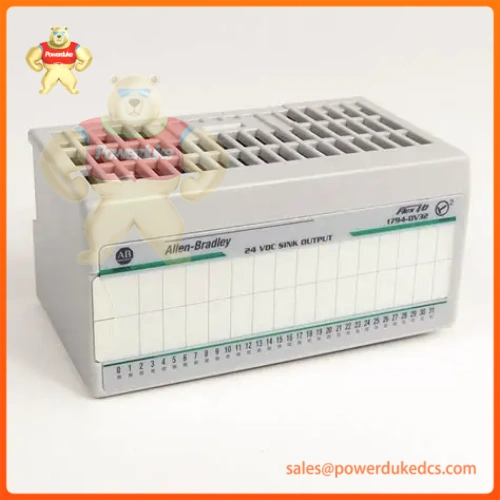
Description
 1. Unboxing & Physical Snapshot
- Model & Brand: Rockwell Automation / Allen-Bradley FLEX I/O Series 8-Channel RTD Input Module (Part No. 1794-IR8)
- Physical Dimensions (Approximate W x H x D): 94.0 mm x 94.0 mm x 69.0 mm (3.7 in x 3.7 in x 2.7 in).
- Estimated Shipping Weight: 0.18 kg (0.40 lbs).
- What’s in the Box: FLEX I/O analog input module, front-panel status LED indicator array, removable terminal base connection interface, and manufacturer compliance documentation.
2. Product Introduction
Industrial process loops and temperature monitoring systems deployed in automated manufacturing lines require precise analog acquisition hardware capable of reading resistance temperature detectors (RTDs) without thermal drift. This Allen-Bradley FLEX I/O RTD module snaps onto standard DIN-rail terminal bases—which is vital for converting multi-channel temperature sensor data into digital variables across distributed automation networks.
The ruggedized polymer housing protects sensitive internal analog-to-digital conversion circuitry from airborne dust and ambient cabinet humidity. Translating low-level sensor resistance changes into clean controller inputs, this hardware maintains strict measurement fidelity under continuous plant floor operation.
3. Core Technical Specifications
| Parameter | Value |
| Module Type | 8-Channel Resistance Temperature Detector (RTD) Input Module |
| Series Compatibility | Allen-Bradley FLEX I/O System Architecture |
| Supported Sensor Types | Pt, Ni, Cu RTD sensors, and direct resistance measurements |
| Conversion Resolution | 16-bit analog-to-digital conversion accuracy |
| Isolation Voltage | 50v (continuous), basic insulation type (field-to-backplane) |
| Operating Temperature Range | -20 °C to +55 °C (-4 °F to +131 °F operational limits) |
| Enclosure Protection Class | IP20 open-style module classification |
| Termination Base Compatibility | Requires compatible 1794 terminal bases (e.g., 1794-TB3, 1794-TB3S) |
4. Global Compliance & Industry Certifications
- Expected Regulatory Approvals: CE Mark, UL Listed (UL 508), cUL, CSA C22.2 No. 14, ATEX/IECEx hazardous location compliance (Class I, Division 2), and RoHS environmental directives.
- Safety & Compliance Impact: Compliance with stringent hazardous location standards guarantees that low-voltage analog signal circuits won’t spark volatile atmospheres when deployed inside Class I, Division 2 control enclosures.
- Verify specific lot certifications with OEM.
5. Long-Term Storage & Asset Preservation Guide
Keep this analog input module sealed inside its original anti-static (ESD) shielding bag to protect sensitive internal microprocessors and precision conversion components from electrostatic discharge events. Maintain warehouse storage conditions at a relative humidity level strictly below 60% to prevent micro-corrosion on the backplane connector pins over extended holding cycles. Store the unit flat on shelving racks, avoiding heavy stacking loads that could crack or warp the polymer housing enclosure.
6. Physical Installation Prerequisites
- Verify that the compatible 1794 terminal base is securely mounted and grounded onto a standard DIN rail prior to module insertion.
- Align the module alignment guide pins carefully with the terminal base socket to prevent bending backplane pins during installation.
- Use shielded twisted-pair cabling for all RTD sensor field connections and ground the shield at one end only to eliminate induced electromagnetic interference.
7. Buyer’s FAQ (Logistics & Compliance Focus)
- Q: What Harmonized System (HS) code applies for international customs clearance on this FLEX I/O module?
- A: Industrial automation control modules, programmable logic controller parts, and analog input units typically classify under HS code 8537.10 or 9032.89. Confirm local code accuracy with your trade compliance broker.
- Q: Does this module ship with a terminal base included?
- A: No. FLEX I/O modules are typically supplied as plug-in units; the matching 1794 terminal base must be ordered separately or sourced from existing panel assemblies.
- Q: How does the Country of Origin (COO) documentation affect our import compliance audit?
- A: Manufacturing origin records correspond to authorized global production facilities for this automation series. Check commercial invoice documentation for precise country records to satisfy trade treaty requirements.
- Q: Is specialized transit insurance recommended during shipment?
- A: Yes. Because precision analog input modules contain delicate calibration circuitry and surface-mount components, comprehensive transit insurance guarding against mechanical shock damage is strongly advised.
- A: Yes. Because precision analog input modules contain delicate calibration circuitry and surface-mount components, comprehensive transit insurance guarding against mechanical shock damage is strongly advised.






