Description
 Meta Description
Technical inventory and procurement breakdown for the ABB PFTL101AE-2.0kN (3BSE004213R1) horizontal web tension load cell. Minimize stock-out risks and manage safety stock.
Technical Overview and Field Specifications
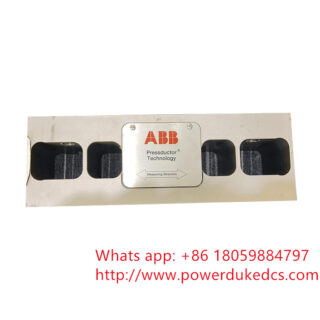
The ABB PFTL101AE-2.0kN (ordering code 3BSE004213R1) is a horizontal-force pillow block load cell tailored for medium-to-heavy web tension monitoring in paper mills, steel strip lines, plastic film extrusion plants, and continuous converting systems. Operating via ABB’s Pressductor magnetoelastic technology, it detects force-induced changes in internal magnetic fields rather than standard foil strain gauges. This eliminates internal active microchips or delicate backing bonding matrices at the immediate measuring node, yielding a high spring constant alongside resilience to factory shocks.
| Parameter | Specification / Value |
| Model Designation | PFTL101AE-2.0kN |
| Ordering Code | 3BSE004213R1 |
| Primary Measuring Axis | Horizontal Force Vectors Only |
| Nominal Measurement Force | 2.0 kN (2,000 N / approx. 450 lbs) |
| Mechanical Overload Capacity | Up to 300% of nominal scaling without shifting the zero-point |
| Deflection at Rated Capacity | < 0.03 mm (Maintains absolute cylinder alignment) |
| Ingress Enclosure Rating | IP67 rated against heavy moisture/washdown conditions |
| Condition Standards | New Original (Factory Sealed), New Surplus, or Refurbished (tested) |
These devices are structurally secured underneath the pillow block bearing brackets of intermediate idler rolls. The raw differential voltage matches perfectly with common processing units like the PFEA111 or PFEA112 tension units, pushing real-time millivolt scaling over low-impedance AC circuits up to the supervisory PLC/DCS node.
 [Moving Web Profile] ────> (Idler / Deflector Roll) ────> [Process Path]
                                      │
                              [Bearing Block]
                                      │
                   ▼──────────────────▼──────────────────▼
                   [  PFTL101AE-2.0kN Horizontal Cell  ]
                   ▲──────────────────▲──────────────────▲
                                      │
                           [Rigid Foundation Bed]
                                      │
                         (Shielded High-Output Cable)
                                      │
                            [PFEA Control Module]
Inventory Strategy & Stocking Recommendations
Managing spares for the 2.0 kN version requires recognizing that while it exhibits superior toughness to lower-range models, it is placed at major stress junctions along the web line. An operational strip snap, raw material jam, or frozen bearing can exert heavy horizontal shear forces that destroy internal primary excitation loops. Factory replacement lead times vary significantly, moving from a standard 6-week window to upwards of 18 weeks depending on raw casting allocations at the OEM production plant.
 [Unbuffered Sourcing Pipeline: Empty Shelf]
 Component Shear ──────────────────────────────> Production Halted (6-18 Weeks)

       [Buffered Strategy: On-Site Safety Buffer Stock]
 Component Shear ──> Mechanical Swap (4 Hours) ──> Calibration ──> Production Resumes
Categorization: Class A Critical Spare
- Classification: Low deployment frequency per machine line, high unit value, severe production stop risk.
- Carrying Cost Allocation: Track inventory turn targets continuously to restrict holding costs to under 12% of total capital value.
- On-Site Recommendation: Keep 1 to 2 units on-site per production building using this sensor footprint.
- Replenishment Thresholds:
- Min Level: 1 unit (Factory Sealed or Certified Remanufactured)
- Max Level: 2 units (per physical factory compound)
- Reorder Point (ROP): Set to 1 unit. Generate a priority purchase order the same shift an active spare is extracted from inventory.
Lifecycle & Vendor Management
- Cross-Site Reserve Allocation: If sister manufacturing sites operate within a 4-hour trucking radius, establish a single pooled pair at a central repository to avoid purchasing excessive stock for each facility.
- Vendor Consolidation: Bundle sourcing under contracted frame agreements with industrial electronics suppliers who guarantee emergency stocking access.
- Surplus Marketplace Vetting: When acquiring units from secondary networks to mitigate long OEM queues, require a verified coil-to-housing insulation resistance check (>100 M\Omega at 500 V DC) before payment clearance.
Scenario Analysis: Plant Deployment vs. Spares Sourcing
Scenario A: Asymmetrical Left/Right Web Skew
In wide-format paper mills, two PFTL101AE-2.0kN cells map both sides of the deflector cylinder to capture asymmetrical tension across the roll face.
- Field Action: If a severe wrapping jam destroys the left cell’s interior coil array, differential loop values crash.
- Stocking Need: Having an identical spare on the shelf allows maintenance to swap out the broken sensor block, connect the pre-run instrumentation lines, and establish zero-point balance parameters within a brief routine shutdown window.
Scenario B: Secondary Sourcing Under Extended Outage
When an unexpected hardware failure hits a plant running without safety stock, relying on standard factory builds can lead to prolonged downtime.
- Field Action: Procurement must look past primary supply networks to leverage verified surplus channels.
- Stocking Need: Because these Pressductor cells rely on passive internal magnetic loops rather than aging active semiconductors, “New Surplus” hardware stored in dry conditions remains completely reliable—making it an excellent alternative for immediate deployment.
Trade-offs and Limitations
Strengths
- High Signal Integrity: Low-impedance AC coil lines exhibit excellent immunity to industrial electromagnetic interference (EMI) from nearby variable frequency drives (VFDs).
- Near-Zero Structural Deflection: Deflection specs (<0.03 mm) keep rolls level and prevent tracking problems or bearing binding under load surges.
- Long Operating Envelope: Solid-steel block designs eliminate the sensor drift common to traditional glue-backed foil strain gauges.
Limitations & Caveats
- Horizontal Vector Only: The PFTL101AE isolates horizontal force vectors. If web geometry is modified during a line upgrade such that force vectors act vertically, this model will output incorrect tension data.
- Precision Flatness Mandate: The base mounting pad must be machined completely level and parallel. Any mechanical twisting or uneven torquing of the anchors causes internal stress, generating severe zero-point offsets that can saturate the PFEA control module’s balancing range.
- Not Recommended For: Low-tension, lightweight film lines (under 100 N total horizontal load force) where the sensor cannot resolve fine signal changes, or heavy metals processing lines that exceed 2,000 N operational forces.
Decision Matrix: Sourcing & Replacement Options
| Sourcing Route | Lead Time | Cost Index | Risk Profile | Best Scenario Application |
| OEM Direct (New) | 6–18 Weeks | 100% | Negligible | Greenfield mill design, planned system overhauls |
| Authorized Surplus (New Sealed) | 1–3 Days | 65–80% | Low | Emergency replacements, safety stock replenishment |
| Certified Remanufactured | 24–48 Hours | 45–60% | Low to Moderate | Backup lines, offline calibration benches |
Quick Conclusions
- Maintain 1 spare unit on the warehouse floor for every 5 running 2.0 kN horizontal Pressductor frames in operation.
- Mandate baseplate flatness checks before mounting a replacement module to avoid structural twisting.
- Conduct insulation tests on all long-term stored inventory every two years to ensure environmental integrity.
- Require complete calibration data sheets before accepting secondary market or surplus units into active inventory.
Frequently Asked Questions
What internal resistance values indicate a healthy PFTL101AE-2.0kN?
Disconnect the module cable from its matching PFEA tension unit. Measure the resistances of both the primary and secondary coil loops using a standard digital multimeter. The readings should register low ohm levels matching factory data sheet baselines. More importantly, verify insulation resistance with a 500 V DC megohmmeter between the coil leads and the outer stainless steel casing; any reading under 100 M\Omega indicates moisture ingress or a ground fault.
Can a PFTL101AE-2.0kN be dropped onto a vertical mounting frame?
No. The mechanical design of the internal magnetoelastic zones in the “AE” series is structured to isolate and measure horizontal force components while deflecting vertical weight loads. Mounting this cell vertically will produce highly inaccurate readings or damage the internal sensor alignment.
How should spare 3BSE004213R1 load cells be stored for long-term standby?
Keep the unit sealed within its original anti-static, moisture-barrier packaging alongside fresh desiccant packs. Store the box in an indoor, climate-controlled warehouse with relative humidity kept under 85% (non-condensing). Under these conditions, the internal components have an almost indefinite shelf life.
Channel Adaptation Notes
Internal Procurement & Maintenance Portal
- Cross-reference part number PFTL101AE-2.0kN with 3BSE004213R1 to prevent accidental orders of vertical models or incorrect load capacities (like the 0.5 kN or 1.0 kN versions).
- Set procurement workflows to automatically search pre-vetted surplus networks when lead times from primary vendors exceed 45 days.
System Integrator & Field Maintenance Guides
- Print out the manufacturer’s exact bolt-torque sequences and include them with the mechanical work order package.
- Ensure technicians realize that any shims utilized under the pillow block bearing housing must cover the full surface area of the load cell’s upper face plate to avoid high stress zones.