Description
 Meta Description
Technical inventory and risk management analysis for the ABB PFCA401F (3BSE024387R3) Millmate web tension controller. Optimize capital efficiency and safety stock.
Technical Overview and Field Specifications
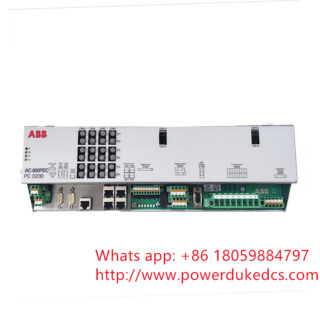
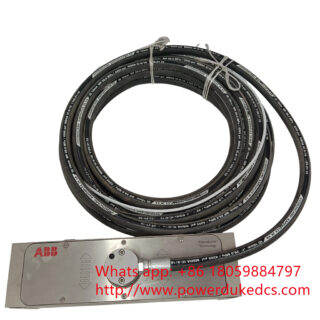
The ABB PFCA401F (ordering code 3BSE024387R3) serves as a specialized, high-performance control unit for Millmate Pressductor strip and web tension measurement systems. Designed to process heavy-duty AC excitation and secondary signals from magnetoelastic pillow block load cells, this processor executes high-speed signal filtration, loop calculations, and zero-point calibration routines.
| Parameter | Specification / Value |
| Model Name | PFCA401F |
| Ordering Code | 3BSE024387R3 |
| Device Type | Millmate Strip Tension Control Electronics Unit |
| Processor Focus | Real-time calculation of strip tension, left/right differential loads |
| Signal Input Handling | Multi-channel input processing for Pressductor sensor pairings |
| Communication / Interfaces | RS-485 serial bus integration, high-accuracy isolated analog loops |
| Enclosure Type / Mounting | Compact chassis, sub-rack or panel mount deployment |
| Condition Standards | New Original (Factory Sealed), New Surplus (tested), or Refurbished |
In sheet metals processing, cold rolling stands, and heavy-gauge paper manufacturing, the PFCA401F plays a critical role. A structural failure on this card instantly blinds the tension management system, halting the downstream winding lines and causing rapid sheet tearing or mill cobbles.
 [Pressductor Load Cell Left] ──┐
                               ├──> [PFCA401F Controller (3BSE024387R3)] ──> [RS-485 / Analog Out] ──> [Main DCS / PLC]
 [Pressductor Load Cell Right] ─┘
Inventory Strategy & Stocking Recommendations
Managing safety stock for the PFCA401F (3BSE024387R3) is driven by long supply lead times. Because this unit belongs to a mature, highly specialized processing niche, factory replacement lead times frequently vary between 10 and 24 weeks depending on batch schedules at the OEM assembly facility.
 [Unbuffered Strategy: Stock Out]
 Processor Fault ──────────────────────────────────> Line Out (10-24 Weeks)

       [Buffered Strategy: 1 Unit On-Site]
 Processor Fault ──> Slide Swap & Flash (2 Hours) ──> Operations Restored
Categorization: Class A Critical Spare
- Classification: High capital value, very low failure frequency, extreme downtime cost impact.
- Carrying Cost Impact: High individual board pricing requires strict control of safety stock levels to avoid locking up unnecessary capital.
- On-Site Recommendation: Keep exactly 1 spare unit on-site per active rolling mill or converting plant.
- Replenishment Thresholds:
- Min Level: 1 unit (Factory Sealed or Tested Surplus)
- Max Level: 2 units (if managing multiple lines within the same plant)
- Reorder Point (ROP): Set to 1 unit. Trigger an immediate sourcing requisition the day the warehouse shelf unit is deployed.
Lifecycle & Vendor Management
- Lifecycle Awareness: As an established Millmate module series, components must be actively monitored for end-of-life (EOL) announcements. Ensure procurement maintains contacts with specialized legacy surplus vendors.
- Cross-Site Allocation: For sister plants operating within a 4-hour radius, consolidate spare reserves to a single shared safety unit instead of maintaining duplicate units at every site.
- Vetting Protocols: When purchasing secondary market cards, require the vendor to supply automated bench-test printouts showing stable excitation voltage generation across all load cell diagnostic pins.
Scenario Analysis: Plant Deployment vs. Spares Sourcing
Scenario A: High-Speed Cold Rolling Stand
During continuous steel strip processing, the PFCA401F actively balances differential hydraulic forces on the mill stand based on real-time sensor inputs.
- Field Action: If a severe power fluctuation causes a component-level short circuit on the processor card, the feedback loop drops offline instantly.
- Stocking Need: A pre-tested spare on the shelf allows instrumentation technicians to slide out the failed card, set the hardware address jumpers, and restore process line validation within a single shift window.
Scenario B: Emergency Strategic Hoarding
When primary factory distribution channels report extensive backorders during a critical hardware shortage:
- Field Action: Procurement must shift focus from standard distribution models to verified industrial surplus networks.
- Stocking Need: Because these boards do not rely on fragile internal backup batteries for structural configuration storage, properly stored “New Surplus” stock remains fully functional even after extended warehouse storage.
Trade-offs and Limitations
Strengths
- Dedicated Pressductor Optimization: Processes complex AC sensor signals directly without requiring external isolation transmitters.
- High Thermal Stability: Solid components handle the ambient heat variations typical of control pulpits near heavy machinery.
- Low Signal Latency: Hard-coded logic ensures fast loop response times for high-speed tension adjustments.
Limitations & Caveats
- Variant Incompatibility: The “F” variant (PFCA401F) features distinct firmware configurations and communication protocols compared to the “S” variant (PFCA401S). Swapping them without verified project engineering adjustments will trigger a bus error.
- Delicate Jumpers: Address allocation relies on physical hardware jumpers. Technicians must manually verify these jumper configurations against the active station configuration before powering up a replacement unit.
- Not Recommended For: Basic strain-gauge load cells from third-party manufacturers; the card is specifically tuned for the electrical characteristics of ABB Pressductor technology.
Decision Matrix: Sourcing & Replacement Options
| Sourcing Route | Lead Time | Cost Index | Risk Profile | Best Scenario Application |
| OEM Direct (New) | 10–24 Weeks | 100% | Negligible | Long-term capital improvements, scheduled system upgrades |
| Authorized Surplus (New Sealed) | 1–3 Days | 70–85% | Low | Emergency asset failure, safety stock replenishment |
| Refurbished / Bench Tested | 24–48 Hours | 45–60% | Moderate | Standby maintenance backups, offline test loops |
Quick Conclusions
- Maintain at least 1 replacement card in safety stock for every plant utilizing active PFCA401F control nodes.
- Double-check and map physical jumper layouts on the spare card before placing it into warehouse inventory.
- Keep stored units in anti-static shielding packaging within climate-controlled environments.
- Verify the specific alphanumeric suffix (F vs. S) to prevent field protocol mismatches during installation.
Frequently Asked Questions
What indicates an internal processing fault on the PFCA401F controller card?
Erratic analog outputs, sudden communication losses on the RS-485 link, or hardware fault LEDs on the front faceplate generally point to internal voltage regulator drift or flash memory degradation. Check the main 24 V DC supply rails for clean voltage delivery before swapping out the processor assembly.
Can a PFCA401F (3BSE024387R3) replace a legacy Millmate controller card?
Yes, provided that the field wiring connections, signal excitation ranges, and firmware communication profiles match the active project parameters. Verify exact system firmware documentation before executing a field upgrade.
What is the recommended shelf life for a spare 3BSE024387R3 unit?
The shelf life is nearly indefinite when stored in its original sealed anti-static packaging within a dry, temperature-controlled environment. Because there are no internal fluid capacitors or volatile memory batteries on the main board, it will not experience performance degradation during extended storage.
Channel Adaptation Notes
Internal Procurement & Maintenance Portal
- Cross-reference part number PFCA401F with ordering code 3BSE024387R3 to ensure compatibility across all internal automated procurement channels.
- Configure automated workflows to prompt specialized surplus sourcing searches if primary factory delivery times exceed 45 days.
System Integrator & Field Maintenance Guides
- Include exact terminal layout diagrams within the preventative maintenance work order packet.
- Remind engineering teams that changing hardware station numbers requires a complete system reboot to reinitialize the communications interface.