Description
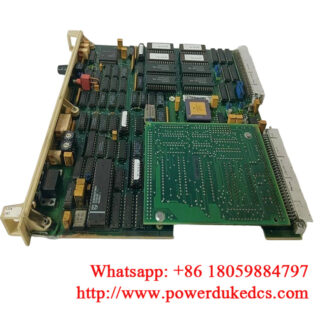
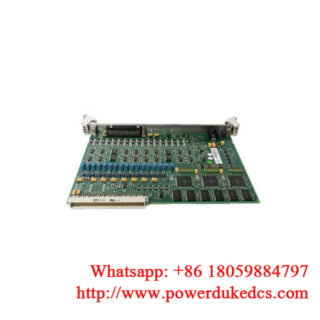
The ABB DSAO130 is a high-performance analog output module belonging to the S100 I/O system, primarily used with Advant Controller 410, 450, and legacy MasterPiece 200 systems. This module provides 16 independent analog output channels, converting digital control signals from the processor into standard 0–20 mA or 4–20 mA current loops to drive actuators, valve positioners, and variable speed drives.
Commercial and Availability Status
-
Condition: New Original (New Surplus) or Refurbished (Certified & Tested)
-
Warranty: 12-Month Comprehensive Warranty
-
Availability: In Stock
-
Lead Time: Ships within 1 to 3 business days
-
Pricing Note: As a widely used legacy module, price is subject to current market stock. Contact our sales team for a firm, project-specific quote.

Technical Specifications
| Parameter | Specification / Value |
| Model Number | DSAO130 |
| Module Type | Analog Output (AO) |
| Number of Channels | 16 Channels |
| Output Signal | 0 to 20 mA or 4 to 20 mA |
| Resolution | 12-bit binary |
| Accuracy | ±0.1% of Full Scale |
| Max Load Impedance | 600 Ω at 20 mA |
| Isolation | Group-wise galvanic isolation |
| Power Consumption | Typically 7.5 W (Internal 5V) + Output Load |
| Backplane Interface | Standard S100 I/O Bus |
Technical Architecture and Operational Logic
The DSAO130 is designed for deterministic control. It utilizes a high-speed digital-to-analog converter (DAC) that ensures smooth, continuous signal transitions, which is critical for the stable operation of control valves and motor controllers.
Signal Formatting
Each of the 16 channels can be individually configured via the Advant Engineering Station (AMPL/Control Builder) to operate in different ranges. The 12-bit resolution provides 4,096 discrete steps, allowing for highly granular control over the field device.
Galvanic Isolation
To protect the central processing unit from field-side electrical interference or accidental high-voltage contact, the DSAO130 features robust galvanic isolation between the internal S100 bus and the output circuits. This architecture effectively eliminates ground loops that could otherwise introduce inaccuracies into the analog signals.
Engineering and Field Deployment Guidelines
1. External Power Supply
The DSAO130 requires an external 24 V DC supply to drive the current loops.
Expert Field Note: If the external 24 V power drops below the required threshold, the “Module OK” LED may remain green, but the output current will “flatline” at 0 mA or freeze. Always monitor the status of the field power supply through a separate digital input or a specialized power monitoring module to prevent undetected loss of control.
2. Termination and Wiring
The module is typically paired with a connection unit (such as the DSTA 131 or DSTA 135).
-
Shielding: Use twisted-pair shielded cable for all analog outputs. The shield should be grounded at the I/O cabinet end only to prevent noise interference.
-
Load Limits: Ensure the total loop resistance (cable resistance + actuator impedance) does not exceed 600 Ω. Exceeding this limit will prevent the module from reaching its full 20 mA output.
3. Redundancy and Safety
In critical applications like turbine steam valve control, the DSAO130 is often used in a redundant configuration. The system can be programmed to use two modules in parallel, where the control logic selects the healthy module or performs an average if both are functional.
Frequently Asked Questions
How does the DSAO130 differ from the DSAO120?
The DSAO130 is the higher-density successor to the DSAO120. While the DSAO120 typically offered fewer channels or lower resolution, the DSAO130 provides 16 channels and improved thermal stability, making it the standard choice for modernizing MasterPiece systems.
What does a flashing “Run” LED signify?
A flashing LED usually indicates that the module is in “Inhibit” or “Service” mode. This means the module is powered and communicating, but the outputs are being held at a safe value (usually 0 mA or last value) while maintenance is being performed on the controller.
Does the module support voltage outputs (0–10 V)?
Natively, the DSAO130 is a current-output module. To achieve a voltage signal, a high-precision 500 Ω resistor can be installed across the output terminals of the connection unit to convert a 0–20 mA signal into a 0–10 V signal, though this must be accounted for in the engineering software scaling.
Are you looking for a replacement for a failed unit, or do you require a full set for a system expansion?