

Description
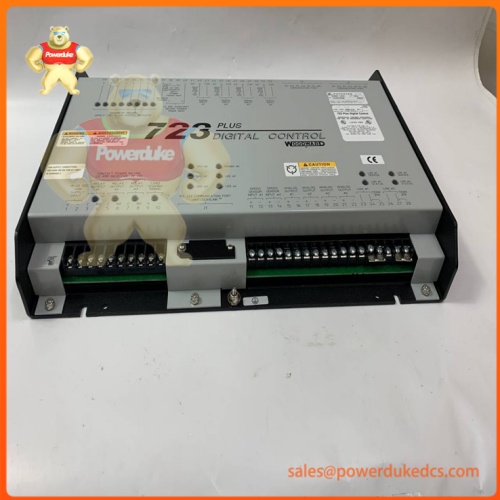
Model & Brand: Woodward / 723PLUS Series (Catalog No. 8280-1001 / Digital Speed & Load Controller)
- Physical Dimensions: Rugged metal chassis profile designed for high-vibration power house and industrial environments (Approx. 413 mm × 292 mm × 60 mm / 16.25″ × 11.5″ × 2.375″ WxLxH layout)
- Estimated Shipping Weight: 2.95 kg (6 lbs 8 oz) (Packaged in multi-layer anti-static ESD shielding and structural industrial foam crating)
- What’s in the Box: 8280-1001 controller assembly, pluggable terminal blocks, connector jumpers, and factory configuration/test verification document.
Industrial power generation plants, oil and gas compressor stations, and marine propulsion systems require precise, reliable speed regulation and load sharing for heavy reciprocating engines and gas turbines. System engineers integrate the Woodward 723PLUS Digital Controller (Catalog No. 8280-1001) into prime mover control panels to manage fuel rack positioning, execute isochronous or droop speed control, handle generator synchronization, and provide multi-unit load sharing (—which is vital for maintaining frequency stability, preventing mechanical overspeed transients, and ensuring continuous automated reliability across complex power distribution topologies).
Control technicians must ensure correct 18–40 VDC power supply polarity, proper shielding on magnetic pickup (MPU) speed sensor wiring, and solid earth-grounding continuity to prevent electrical noise from distorting critical governor telemetry.
| Parameter | Value |
| System Platform | Woodward 723PLUS Digital Control Series (Ctrl Assm 9906-619) |
| Controller Type | Programmable digital speed and load controller |
| Speed Inputs | Dual independent MPU or proximity switch inputs with torsional filtering |
| Input Power | 18 to 40 VDC (40 W nominal power consumption) |
| Analog I/O | 4 configurable analog inputs, 3 analog outputs |
| Discrete I/O | 8 discrete inputs, 3 configurable relay discrete outputs |
| Communication Ports | Serial communication ports supporting Modbus and Servlink protocols |
| Operating Temperature | -40°C to +70°C (-40°F to +158°F) ambient chassis rating |
| Enclosure / Mounting | Metal chassis designed for industrial panel backplate mounting |
Auditors inspecting industrial power generation houses, turbine skids, and hazardous area control panels demand rigorous documentation verifying electrical safety, isolation integrity, and international regulatory compliance.
- CE Mark: Confirms conformity with European Union directives covering electromagnetic compatibility (EMC) and low-voltage safety.
- CSA Certified: Validates North American safety standards for deployment in Class I, Division 2, Groups A, B, C, and D hazardous locations.
- Low Voltage & EMC Directives: Complies with harmonized industrial electrical safety standards.
- RoHS Compliance: Restricts hazardous chemical substances in electronic component manufacturing.
Compliance Note: Compliance with rigorous industrial environmental and electrical standards guarantees that internal microprocessor circuits withstand high electrical noise floors and thermal stress without control lockup. Verify specific area classification control drawings before panel energization.
Dormant digital controllers stored in warehouse stockroom bins face terminal oxidation on pluggable screw connectors, dust accumulation on circuit boards, and internal component aging if environmental parameters exceed strict limits.
Keep the controller assembly sealed tightly inside its original anti-static (ESD) moisture-barrier bag to safeguard internal microprocessors, flash memory, and communication chips from static discharge. Maintain warehouse storage temperatures between -40°C and +85°C with relative humidity kept strictly below 95% non-condensing to prevent micro-corrosion on internal traces and connector pins. Ensure the unit remains protected from heavy drop forces that could warp the metal chassis or fracture internal printed circuit boards.
Panel layout clearance, proper thermal management spacing, and secure terminal torque dictate physical installation success. Ensure all control power feeds and actuator loops are completely locked out (LOTO) prior to handling. Mount the 8280-1001 securely to the subpanel backplate, verify that shield drain wires are tied properly to the designated cabinet ground studs, and upload application configuration software via the programming port prior to system commissioning.
- What is the correct HS Tariff Code for international customs clearance?
Industrial automatic regulators and electrical controllers classify under harmonized code 8537.10 (or regional equivalent 8538.90), though exact regional rulings should be verified with your broker.
- Does this controller require custom programming before operation?
Yes, the 8280-1001 is a programmable unit; custom control logic, PID tuning parameters, and I/O configurations must be loaded using Woodward’s GAP programming tool or WatchWindow software.
- How does the Country of Origin (COO) impact global trade compliance?
The verified COO dictates trade agreement qualification and must match commercial shipping paperwork to eliminate border customs clearance delays.
- Why is comprehensive transit insurance mandatory for this component?
Precision microprocessors, multi-layer circuit boards, and sensitive electronic components can suffer structural micro-cracks or solder joint fatigue under severe drop impacts during freight transit.






