Description
1. Product Title
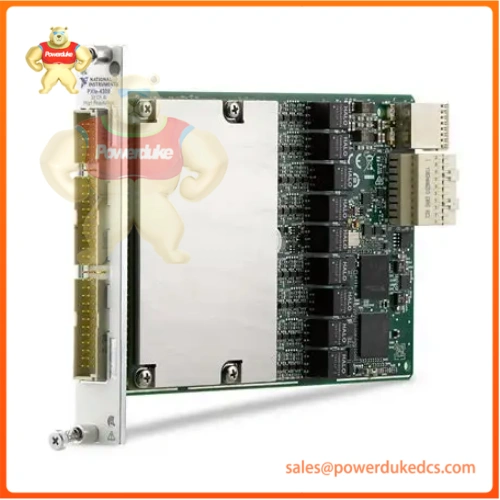
NI PXIe-4468 – 2-Channel, 204.8 kS/s PXI Sound and Vibration Design Module

2. Product Overview
The PXIe-4468 is a high-precision, high-dynamic-range analog input and output module designed by National Instruments (NI). It is specifically engineered for sound and vibration (S&V) applications that require extreme accuracy, such as audio testing, acoustic measurements, and structural vibration analysis.
The module solves the challenge of capturing low-level signals in noisy environments by utilizing 24-bit analog-to-digital converters (ADCs) and digital-to-analog converters (DACs). With a maximum sampling rate of 204.8 kS/s per channel and integrated electronic piezoelectric (IEPE) signal conditioning, the PXIe-4468 provides an all-in-one solution for interfacing directly with sensors like accelerometers and microphones without needing external amplifiers.
3. Technical Specifications
- Brand: National Instruments (NI)
- Model: PXIe-4468
- Channels: 2 Analog Inputs, 2 Analog Outputs
- Resolution: 24-bit
- Max Sampling Rate: 204.8 kS/s (simultaneous)
- Dynamic Range: Up to 118 dB
- Input Coupling: AC, DC, and IEPE (4 mA or 10 mA)
- Output Type: Differential or Single-ended
- Synchronization: Integrated PXI Express timing and triggering
- Connectivity: BNC or SMB (depending on specific connector block)
4. Key Features & Benefits
- Superior Dynamic Range: The 118 dB dynamic range allows the PXIe-4468 to resolve very quiet signals even in the presence of large interference, which is critical for high-fidelity audio and seismic monitoring.
- IEPE Conditioning: The built-in 4 mA/10 mA current source simplifies wiring for industry-standard sensors (accelerometers/microphones), reducing system complexity and cost.
- Flexible Output: The two analog output channels can be used to generate high-purity sine waves or arbitrary waveforms for stimulus-response testing.
- Phase Linearity: Designed with digital anti-aliasing filters that provide excellent phase matching between channels, essential for applications like sound intensity measurements or modal analysis.
5. Application Scenarios
- Audio Quality Analysis: Testing speakers, headphones, and microphones for total harmonic distortion (THD) and frequency response.
- NVH (Noise, Vibration, and Harshness): Real-time monitoring of automotive engines or industrial machinery to identify mechanical wear or structural resonances.
- Structural Health Monitoring: Measuring the vibration of bridges or buildings during seismic events using high-sensitivity accelerometers.
- Underwater Acoustics: Capturing sonar signals or hydrophone data where low-noise floors are mandatory.
6. Frequently Asked Questions (FAQ)
- Q: Does the PXIe-4468 require a special controller?
- A: It requires any standard PXI Express or PXI Hybrid chassis with a compatible PXI Express controller.
- Q: Can I use this module for high-voltage measurements?
- A: No. The PXIe-4468 is designed for low-voltage signal acquisition (typically ±10 V or ±42 V peak, depending on settings). Always check the specific voltage limits in the manual to avoid damaging the 24-bit converters.
- Q: How do I synchronize multiple PXIe-4468 modules?
- A: Because it is a PXI Express module, it uses the 100 MHz PXIe_CLK100 backplane clock to achieve nanosecond-level synchronization across multiple modules in the same chassis automatically.
NI GPIB-140A NI PXIe-1095 NI PXIe-1095 – 18
- A: Because it is a PXI Express module, it uses the 100 MHz PXIe_CLK100 backplane clock to achieve nanosecond-level synchronization across multiple modules in the same chassis automatically.