

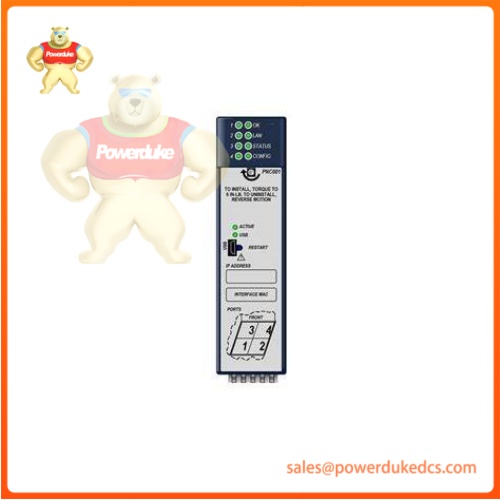
Description

- Model & Brand: GE Fanuc / Emerson PACSystems RX3i IC695PNC001
- Physical Dimensions: 128 mm x 103 mm x 70 mm (Single-slot universal backplane module)
- Estimated Shipping Weight: 0.68 kg (Packaged in industrial anti-static foam carton)
- What’s in the Box: Printed circuit board assembly with extruded aluminum faceplate, dual RJ-45 ports, dual SFP cages, Micro USB configuration port, and factory inspection certificate.
Engineers plug this communication module directly into the main RX3i universal backplane slot to link the central processor with heavy distributed plant networks. High-speed industrial environments demand strict node capacity, routing deterministic packet streams across optical fiber or copper Ethernet links (—which is critical for sub-millisecond motion synchronization).
Network architecture rules dictate that this controller must reside within the primary CPU rack rather than remote expansion drops. Maintain proper bus connection integrity during insertion to prevent backplane pin damage from electrostatic discharge.
| Parameter | Value |
| Module Type | PROFINET Controller (Version 2.2 General Class A) |
| Backplane Support | RX3i Universal Backplane (Main Rack Only) |
| Internal Power Draw (3.3 VDC) | 0.5 A baseline (up to 1.2 A with dual SFP devices) |
| Internal Power Draw (5.0 VDC) | 1.5 A maximum |
| Heat Dissipation | 14.2 BTU/hr operational thermal output |
| Memory Limits | 128 KB combined input/output communication memory |
| Communication Ports | 2x RJ-45 Ethernet, 2x SFP fiber cages, 1x Micro USB setup port |
| Operating Temperature | 0°C to +60°C ambient enclosure range |
| Vibration Resistance | 1G operational acceleration from 10 to 500 Hz |
| Maximum Device Capacity | 64 I/O devices per controller (255 per network) |
Auditors inspecting high-speed automation networks require formal paperwork verifying electrical safety and emission compliance. This network controller carries major international agency approvals.
- CE Mark: Confirms adherence to European Union electromagnetic compatibility (EMC) and low-voltage standards.
- UL/cUL Listed: Validates North American industrial control safety requirements for ordinary locations.
- ATEX / IECEx: Permits safe operation inside hazardous Class I Division 2 or Zone 2 areas when housed in sealed enclosures.
- RoHS Compliance: Restricts hazardous material content in electronic manufacturing processes.
Compliance Note: A UL listing ensures internal component spacing prevents arc flash propagation during power surges. Verify specific lot conformity directly with Emerson or GE Fanuc prior to final audit reviews.
Dormant network interface cards suffer from internal crystal drift and semiconductor corrosion if warehouse environments lack strict climate control. Technicians should manage shelf inventory using rigorous preservation steps.
Keep the module sealed tightly inside its original anti-static (ESD) moisture-barrier bag to shield sensitive transceiver circuits from electrostatic fields. Maintain storage room relative humidity strictly below 60% to prevent micro-oxidation on the backplane edge connector fingers. If inventory records indicate the unit has sat on a shelf past 24 months, execute a controlled bench power test to verify microcontroller stability before field deployment.
Backplane slot allocation and thermal parameters dictate physical placement inside the cabinet. Leave at least 50mm of clearance above and below the rack chassis to allow natural convective airflow across the extruded aluminum faceplate. Secure the module firmly using the spring-loaded retention latches to maintain low-impedance ground continuity with the metallic backplane chassis.
- What is the correct HS Tariff Code for customs processing?
Industrial communication and network controller cards classify under international harmonized code 8538.90.8180, though verify regional rulings with your broker.
- Does this replacement unit ship with pre-loaded configuration firmware?
Units ship with factory baseline firmware; technicians must load project-specific IP addresses and hardware configurations via programming software before active network polling.
- How does the Country of Origin (COO) impact global trade compliance?
The verified COO dictates trade agreement qualification and must match the commercial invoice to prevent border transit delays.
- Why is comprehensive transit insurance mandatory for this component?
Delicate fiber optic transceiver cages and surface-mount oscillator crystals can fracture under heavy mechanical shock loads during express freight transport.






