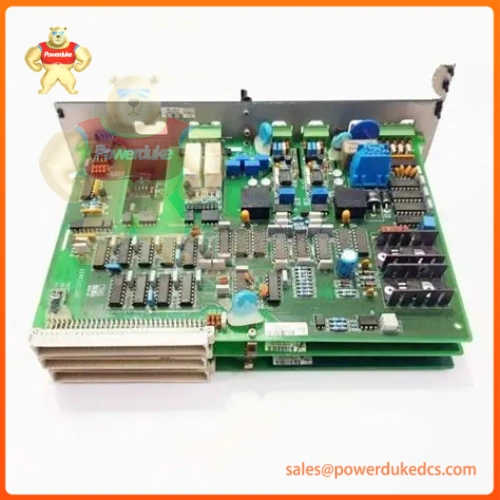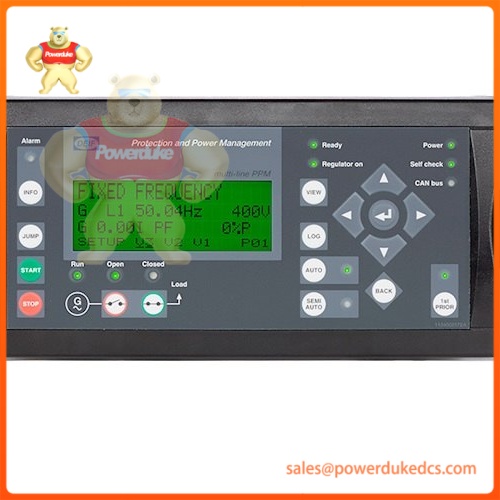
Description
1. Unboxing & Physical Snapshot
- Model & Brand: DEIF A/S — PPM-3 (Protection & Power Management System)
- Physical Dimensions: Modular industrial DIN-rail mount or rear-panel mount design engineered for maritime switchboards and power control cubicles.
- Estimated Shipping Weight: 2.5 kg (5.5 lbs) packaged in custom anti-static padding and a rugged structural shipping carton.
- What’s in the Box: PPM-3 controller module, plug-in screw terminal blocks, backup engine interface card (for backup shutdown functionality), and quick-start safety documentation (note: display units, expansion I/O modules, and communication cables are ordered separately).
2. Product Introduction
Managing multi-generator power plants on marine vessels and offshore platforms requires flawless synchronization, fast load-sharing, and comprehensive system protection. The DEIF PPM-3 is a market-leading, fully redundant Protection and Power Management System (PMS) designed to control complex power networks comprising up to 16 diesel generators, shaft generators, shore connections, bus tie breakers, and emergency generators.
Engineered with multi-master redundancy, integrated three-phase measuring circuits, fuel-optimization features, and a built-in micro-PLC (M-Logic), the PPM-3 ensures maximum plant uptime and stability. Marine engineers, switchboard builders, and offshore asset operators rely on this platform to prevent blackouts, automate load-dependent start/stop sequences, and meet stringent maritime classification standards.
3. Core Technical Specifications
| Parameter | Value |
| Product Family | DEIF PPM-3 Protection & Power Management System |
| Supported Applications | Diesel Generators (DG), Shaft Generators (SG), Shore Connections (SC), Bus Tie Breakers (BTB), and Emergency Diesel Generators (EDG) |
| Maximum Plant Capacity | Up to 16 diesel generators, 2 shaft generators, 2 shore connections, and 8 bus tie breakers |
| System Architecture | Fully redundant multi-master solution via dual/redundant CANbus architecture |
| Voltage Measurement | True RMS three-phase voltage measurement up to 690V AC |
| Engine Interface | Dedicated backup safety shutdown unit with independent microprocessor and power supply |
| Communication Protocols | Modbus, CANopen, J1939 (engine ECU interface) |
| Mounting Options | DIN-rail mount or rear-panel switchboard installation |
| Operating Temperature | -20^\circC to +70^\circC (harsh marine environment tolerance) |
4. Global Compliance & Industry Certifications
Power management controllers deployed in maritime navigation and offshore oil/gas sectors must satisfy rigorous international marine society rules.
- Certifications: Marine class approvals from major classification societies (DNV, Bureau Veritas, Lloyd’s Register, etc.), CE conformity, and industrial EMC/safety standards.
- Safety Relevance: The redundant multi-master communication loop and isolated backup engine shutdown microprocessor prevent catastrophic single-point-of-failure blackouts, ensuring continuous propulsion and emergency power availability.
- Audit Note: Maintain system configuration backups via DEIF’s software tools and keep periodic synchronization test logs updated in your vessel management system (VMS) to pass flag state and class surveys.
5. Long-Term Storage & Asset Preservation Guide
Spare switchboard controllers stored in harsh shore warehouses or ship lockers face humidity, thermal cycling, and terminal corrosion risks over extended storage cycles. Preserve your asset by executing these procedures:
- Maintain climate-controlled storage environments where temperatures stay between +10^\circC and +30^\circC with relative humidity kept under 60% non-condensing.
- Keep the module sealed inside its original anti-static moisture-barrier bag with fresh desiccant pouches.
- Protect rear-plane connector pins from airborne salt mist, dust accumulation, and mechanical bending prior to final switchboard integration.
6. Physical Installation Prerequisites
Proper cabinet grounding, clean signal wiring separation, and strict adherence to safety lockout procedures are mandatory when installing power management modules.
- Clearance Space: Allow adequate ventilation space around the DIN-rail or rear-panel installation area to prevent localized heat buildup inside dense switchboard sections.
- Wiring Integrity: Ensure shielded twisted-pair cables are utilized for redundant CANbus and communication lines to eliminate electromagnetic interference (EMI) from heavy-duty inverter drives or generator busbars.
- Power Isolation: De-energize and lock out (LOTO) all auxiliary power feeds, breaker control circuits, and high-voltage potential transformer (PT) inputs before servicing or swapping hardware modules.
7. Buyer’s FAQ (Logistics & Compliance Focus)
Q: What Harmonized System (HS) Tariff Code applies to the DEIF PPM-3 controller for international shipments?
A: Industrial electrical automatic regulators, switchboard control modules, and marine power management hardware typically classify under HS code 8538.90.0000 or 9032.89.0000. Always confirm exact classifications with your customs broker.
Q: Are there different software variants for different generator types?
A: Yes, the hardware platform supports specific application variants depending on its role—such as PPM-3 DG (Diesel Generator), PPM-3 SG (Shaft Generator), PPM-3 SC (Shore Connection), or PPM-3 BTB (Bus Tie Breaker).
Q: What is the Country of Origin (COO) for trade compliance record-keeping?
A: DEIF power control hardware is engineered and manufactured in primary global facilities located in Denmark, requiring correct origin paperwork for international trade.
Q: Is specialized shock-resistant packaging required for air freight transit?
A: Yes, because switchboard processor cards contain sensitive surface-mount electronics, robust double-box crating and anti-vibration cushioning are essential during urgent global courier delivery.